


London River - The Thames Story
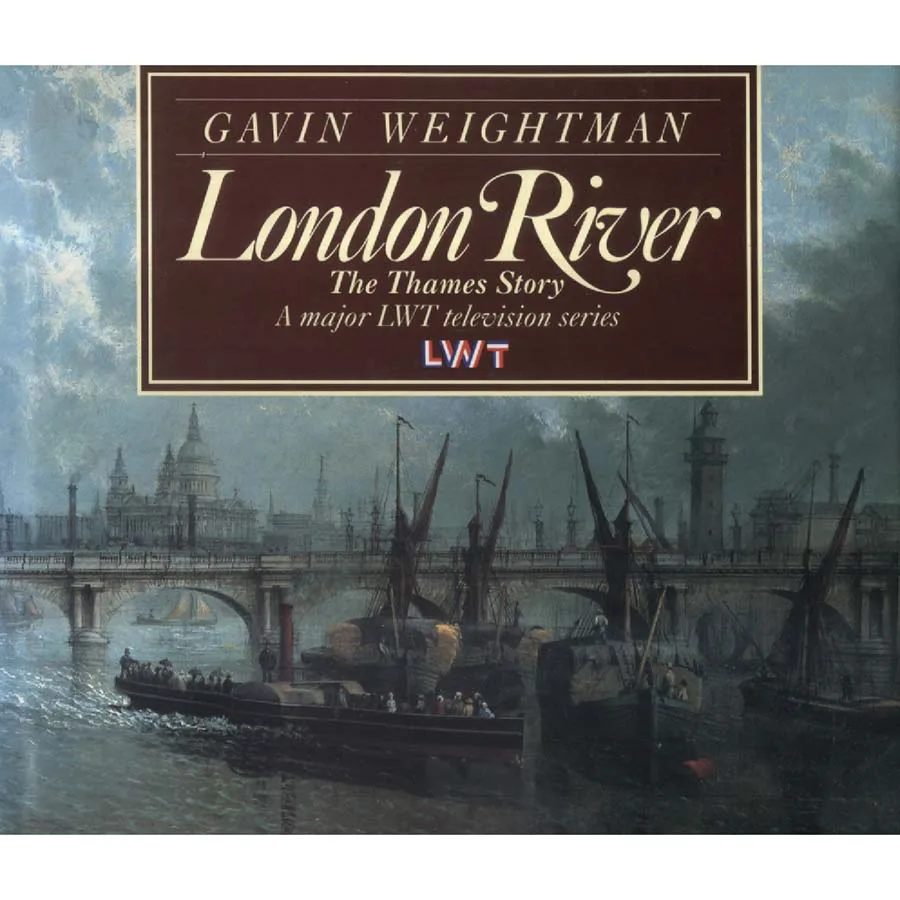
Publisher: Guild Publishing
Format: Hardback
ISBN: none
London River – The Thames Story (1990) by Gavin Weightman
Guild Publishing | ISBN: None | Condition: Good
There are rivers, there are great rivers, and then there is the Thames, that magnificently muddy, stubbornly meandering stretch of water which has spent the best part of two thousand years serving as London’s principal highway, commercial lifeline, open sewer, defensive barrier, industrial artery and occasional resting place for people whose acquaintances were not particularly concerned about their continued wellbeing. In London River – The Thames Story, Gavin Weightman explores the extraordinary history of the waterway that made London possible, enriched an empire and somehow survived centuries of humanity’s most determined attempts to turn it into something resembling an enormous municipal drain.
The Thames is, in many respects, the real founder of London. Long before estate agents began describing converted warehouses as desirable riverside residences with outstanding investment potential, the river was attracting traders, settlers, soldiers, merchants and opportunists to its banks. The Romans recognised its strategic importance, established Londinium and began a relationship between city and river that would eventually produce one of the most powerful commercial centres in the world, although they probably did not anticipate the arrival of luxury apartments costing several million pounds overlooking what had once been a working dock.
Weightman’s account takes the reader through the remarkable transformation of the Thames from a natural waterway into the commercial engine of a great maritime city. For centuries, the river was crowded with vessels of every conceivable description, carrying passengers, livestock, timber, coal, food, manufactured goods and the countless commodities upon which London’s prosperity depended. The river was not merely a picturesque feature of the landscape; it was a vast, noisy, dangerous and astonishingly busy workplace, where fortunes were made, fortunes were lost and unfortunate individuals occasionally discovered that falling into the water was considerably easier than getting out again.
At the height of London’s maritime importance, the Thames was one of the busiest waterways on Earth. Ships arrived from distant corners of the globe, bringing goods from an empire whose commercial reach extended across oceans and continents. Warehouses lined the waterfront, cranes swung above crowded wharves, and armies of dockers, lightermen, watermen, merchants and labourers kept the immense machinery of trade in motion. It was a world of astonishing enterprise and relentless physical labour, with little resemblance to the modern riverside where former industrial buildings have been transformed into restaurants serving artisan bread at prices that would have astonished the men who once unloaded sacks of grain nearby.
The river also developed its own extraordinary society. Watermen transported passengers, lightermen moved cargo between vessels and wharves, and generations of families earned their living from occupations that demanded intimate knowledge of tides, currents, shifting channels and the thousand hazards of navigating London’s crowded waterfront. These were not recreational boaters wearing expensive waterproof clothing and discussing marina facilities. They were working people whose livelihoods, and sometimes their lives, depended upon understanding the moods of a river that could be as treacherous as it was commercially indispensable.
Of course, the Thames was never simply a place of respectable commerce. Wherever large amounts of valuable merchandise change hands, there will inevitably be individuals who prefer acquiring it without the inconvenience of paying. The London waterfront developed a colourful underworld of thieves, smugglers, receivers, fraudsters and assorted opportunists, all contributing in their own distinctive way to the circulation of wealth. Some worked extraordinarily hard at avoiding honest employment, demonstrating that criminal enterprise can require almost as much effort as legitimate business, although with rather less reliable pension provision.
The river also played a central role in London’s less glamorous domestic arrangements. For centuries, the city treated the Thames as a convenient destination for practically anything it wished to get rid of, including sewage, industrial waste, household refuse and assorted unpleasant substances that modern environmental regulations would regard with considerable alarm. The resulting conditions were occasionally spectacularly offensive, culminating in the notorious Great Stink of 1858, when the smell became so appalling that even Members of Parliament, normally well accustomed to an unpleasant atmosphere, found it difficult to continue their proceedings.
The transformation of London’s sanitation system was one of the great engineering achievements associated with the river. Joseph Bazalgette’s enormous sewerage works helped rescue the capital from the consequences of its own success, demonstrating the curious tendency of Victorian civilisation to create gigantic public-health disasters and then solve them through equally gigantic engineering projects. The Thames gradually became something rather more agreeable than an open sewer, although the process was long, expensive and frequently interrupted by the discovery that industrial progress and environmental responsibility were not always enthusiastic companions.
Bridges, tunnels, embankments and docks changed the character of the river as London expanded. Each new engineering achievement altered the relationship between the city and its waterway, making some older occupations obsolete while creating opportunities for new industries and developments. The Thames became both an obstacle to be crossed and a resource to be exploited, an inconvenient geographical feature whenever someone wanted to build a road, and an invaluable commercial advantage whenever somebody wanted to transport several thousand tons of merchandise.
The history of the Port of London is particularly fascinating because its rise and transformation reflect the wider fortunes of Britain itself. The great enclosed docks represented extraordinary investments in commercial infrastructure, designed to accommodate the expanding demands of international trade. Entire communities grew around the docklands, developing their own identities, traditions and economies, while the surrounding neighbourhoods became closely associated with the industries and shipping companies upon which their inhabitants depended.
Yet even the busiest ports are not immune to technological change. Containerisation, larger vessels and the movement of cargo-handling facilities downstream eventually transformed London’s traditional docks. Industries that had sustained generations disappeared or relocated, leaving vast stretches of waterfront awaiting an entirely different future. Where dockworkers once handled cargo beneath towering cranes, developers eventually discovered the enormous commercial potential of describing industrial buildings as ’characterful’, ’exclusive’ and ’within convenient reach of Canary Wharf’.
There is something wonderfully ironic about the transformation of the London riverside. Buildings originally constructed to store goods, shelter workers or support maritime industries have become some of the most desirable properties in the capital. Warehouses once associated with sweat, noise, coal dust and the smell of imported commodities now command extraordinary prices precisely because they retain visible evidence of their industrial past. Apparently, exposed brickwork becomes considerably more attractive once the people who actually worked among it have departed.
But London River is more than a story of trade, engineering and commercial change. The Thames is also a river of human experiences, its history inseparable from the people who lived, worked, travelled and sometimes died along its banks. Royal processions, public celebrations, maritime disasters, industrial disputes, everyday journeys and the constant movement of goods and people all contributed to a rich and frequently turbulent social history.
The river has also inspired generations of artists, writers, poets and observers, who have found in its changing waters a reflection of the city itself. Sometimes majestic, sometimes sinister, occasionally beautiful and frequently rather brown, the Thames possesses a character that has fascinated people for centuries. It can be admired from the terrace of a fashionable restaurant, viewed from a commuter train or contemplated from one of London’s many bridges, although its appearance varies considerably according to the weather, the tide and the amount of money one has just spent on lunch.
Gavin Weightman brings a historian’s interest in the practical realities of everyday life to this remarkable subject, examining the river as an essential part of London’s development rather than merely an attractive geographical backdrop. The result is a fascinating journey through commerce, industry, social change and urban history, revealing how profoundly the fortunes of the capital have been shaped by the stretch of water running through its centre.
For anyone interested in London’s past, the book offers a particularly rewarding way of understanding the city. Streets, bridges, embankments and former docklands take on different meanings when viewed through their maritime history. Familiar landmarks become reminders of vanished industries, forgotten occupations and enormous engineering achievements, while the modern waterfront begins to reveal traces of the astonishingly busy working river that once dominated the capital’s economy.
Published in 1990, this Guild Publishing edition is itself an interesting period piece, appearing at a time when London’s docklands were undergoing dramatic redevelopment and the city’s relationship with its river was being transformed once again. It captures an appreciation of the Thames and its historical importance at a particularly significant moment, before many of the subsequent changes to the riverside had fully taken shape.
For readers familiar only with today’s Thames, with its sightseeing boats, tourist cruises, riverside apartments and occasional discussions about whether swimming in it is an entirely sensible undertaking, the book provides a reminder of just how different the river once was. The modern experience of watching a pleasure boat pass beneath Tower Bridge is a far cry from the days when the waterway was congested with working vessels and the entire commercial life of the city seemed to depend upon the efficient unloading of ships.
This 1990 Guild Publishing edition is offered in Good condition by Crappy Old Books, a bookseller with a particular affection for historical volumes that reveal how places familiar to us today developed from something altogether different. No ISBN is recorded for this edition, which is hardly an obstacle to enjoying a book about a river that managed to function perfectly adequately for nearly two thousand years without a barcode.
An excellent addition to any collection of London history, maritime heritage, British industrial history or books about the development of great cities, London River – The Thames Story will appeal to readers fascinated by the capital’s docks, shipping, bridges, waterfront communities and the remarkable individuals who made their living upon the water.
It would also make an absorbing companion for anyone exploring the Thames Path, wandering through the former docklands or standing beside the river wondering why such a comparatively modest waterway once possessed the commercial importance of an international empire. The answer, as this book helps demonstrate, is that a river need not be especially beautiful, wide or even pleasant-smelling to become one of the most significant waterways in history.
A richly entertaining exploration of London’s greatest geographical asset, from its bustling maritime past to the extraordinary transformation of its working waterfront, and a reminder that the history of the capital is, to a remarkable extent, the history of the river that runs through it.
And perhaps the Thames deserves rather more credit than it usually receives. Empires have risen and fallen, governments have come and gone, monarchs have lost their heads, industries have vanished and entire districts have been rebuilt beyond recognition, yet the river continues flowing through London with an admirable indifference to the whole performance.
After two thousand years of watching humanity’s ambitions, triumphs, disasters and property developments, it has presumably concluded that the wisest policy is simply to keep moving.
Crappy Old Books: rescuing the past one book at a time, without charging extra for waterfront views, historical atmosphere or the occasional whiff of Victorian sewage.
Keep browsing: See more History books Other books by Gavin Weightman
